Home / Services / SEO / Technical SEO
Technical SEO audits with a clear route to fixes.
Important pages are hard to find, an audit has raised concerns, or a recent change needs checking. ARKIELLO helps you establish the problem, agree the technical work and verify the changes on the live website.
For
Business owners and website teams
Start with
Affected pages and the evidence
Deliverables
Review, agreed fixes and verification
Start with the actual problem
Know what needs attention before buying more work.
A page can be published without appearing in the blog archive. It can be discoverable without being indexed, or indexed without ranking for the search you expected. These situations need different decisions.
We begin with the pages that matter to your business, what you expected to happen and what the current evidence shows. That can include a direct page check, the route visitors use to find it and available Search Console information. A tool warning alone does not establish the cause or the value of a proposed repair.
Our guide to indexing versus ranking helps you describe the issue. If the site is already attracting suitable visitors but they do not enquire, the website enquiry guide may be the more useful starting point.
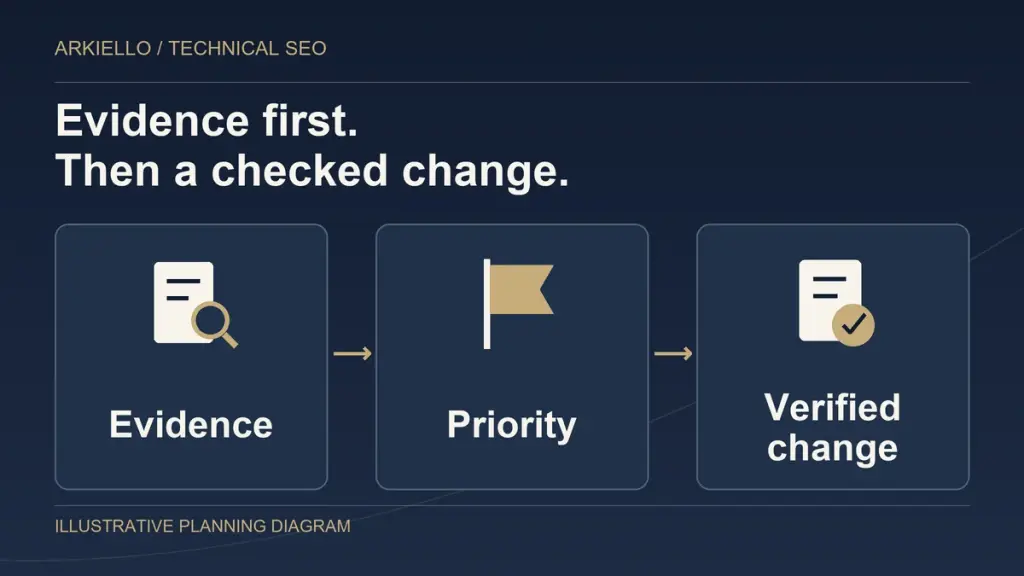
Agree the investigation
A review tied to your important pages.
The proposal names the page groups, questions and checks. A targeted issue needs a different scope from an investigation across templates or a recently migrated website.
Publication and internal discovery
Check whether intended pages are live and reachable through useful navigation, archives and contextual links. Compare the content inventory with what the public website actually exposes.
Crawling, index settings and canonical choices
Review relevant response status, crawl access, index directives, preferred URLs and sitemap entries. Confirm the intended purpose of duplicate, private or excluded pages before changing their settings.
Rendered content and shared templates
Assess whether important content and links appear in the public page, including templates that affect many URLs. Separate a source or editor view from what visitors and crawlers can receive.
Performance and useful page information
Investigate relevant loading or usability concerns with a stated baseline. Review applicable titles, descriptions and structured data. A tool score or schema markup is not a ranking guarantee.
Change priorities and responsibilities
Record the evidence, affected pages, proposed action, dependencies and the person responsible. Agree which changes ARKIELLO will implement and which require your developer, host or platform provider.
Release and verification evidence
Define staging checks, approvals, a recovery approach and live acceptance checks for the agreed changes. Record remaining limitations and any Google processing still outstanding.
A report you can act on
Connect each finding to an accountable next step.
A useful finding states what was observed, which pages are affected, why it matters and what evidence would show the change is complete. The work is easier to commission when investigation and implementation are named separately.
For example, if older articles are public but absent from an archive, the agreed repair might cover archive navigation and checks that every published article remains reachable. Adding the URLs to a report or requesting indexing does not complete that website repair. The team still needs to release and verify the navigation.
Read audit reports versus implemented fixes for a practical finding-to-fix record. It helps you compare deliverables, rather than the number of warnings in different tools.
From our own website
Published content needs a usable discovery path.
On 18 October 2026, our review of ARKIELLO’s Insights found 27 existing articles already public. The listing showed ten articles without pagination, leaving 17 older articles unavailable through that listing. The issue was navigation, not unpublished content.
We repaired the archive navigation and added checks that compare the published article inventory with the generated pages. Explore the current Insights archive and read how we distinguish publication from website discovery. Those historical counts describe the review before the repair; they are not the site’s current article count.
This example demonstrates diagnosis, implementation and verification. It does not establish an increase in Google indexing, rankings or enquiries. For the person leading the work and wider project context, see Romeo’s background and the ARKIELLO website project.
Choose the appropriate scope
A focused repair, or a broader programme?
A defined technical concern
A specific group of inaccessible pages, a navigation gap or a change in website behaviour can justify a targeted review and agreed repairs. The scope needs a clear question and a way to check the result.
Continuing search and content work
Technical improvements do not replace a useful offer, relevant content or ongoing business decisions. Our broader SEO service covers the continuing strategy conversation. Use Local SEO when the main issue concerns genuine local discovery and business information.
A redesign, migration or care requirement
If a platform change is needed, the website redesign service addresses content, design and URL continuity. Routine updates and recurring support belong in an agreed maintenance scope. We establish these boundaries before treating everything as technical SEO.
How the work moves forward
Review, implement and verify.
Describe the problem
Share affected public URLs, the expected behaviour, when the issue appeared and relevant recent changes. Identify the pages and customer actions that matter most.
Agree evidence and scope
Confirm the available reporting and access, questions to investigate, deliverables, exclusions and review stages. Identify who can approve and release changes.
Implement the agreed changes
Prepare the specified improvements or a handover for your existing developer. Review the affected templates and connected journeys before production release.
Check the public result
Verify the released pages and agreed acceptance conditions. Record before-and-after evidence, unresolved dependencies and follow-up needed while Google processes changes.
Cost and timing depend on the platform, affected templates and URLs, access, third-party dependencies and whether implementation is included. A quote follows the agreed scope. We do not promise a fixed ranking position or a search-result deadline.
Questions
Before commissioning technical SEO.
What does a technical SEO review cover?
The agreed scope can include important URLs, crawling and indexing settings, canonical choices, navigation, sitemap coverage, rendered content and relevant performance or structured-data issues. The proposal identifies what will be investigated, the evidence available and what falls outside that review.
Does the audit include fixing every issue?
An audit and implementation are different deliverables. We agree whether the engagement covers investigation, a prioritised action plan, specified repairs or a combination. If another developer owns the changes, the handover identifies the affected pages and the checks needed after release.
Will technical fixes guarantee indexing or higher rankings?
No. Correcting a website issue can remove a barrier or improve a page’s discovery and usability. Google still decides whether to crawl, index and show the page for a search. An accepted indexing request is a crawl-queue request, not a confirmed ranking result.
Do I need a new website first?
A specific template, navigation or configuration repair may be enough. We examine the affected pages and platform before suggesting a rebuild. If redesign or migration is needed, its content, URL and launch responsibilities are agreed separately.
Can you work with our existing developer?
Yes. We can define the technical findings and acceptance checks, then agree who will implement, approve and verify each change. Access, deployment control and any limits imposed by the platform need to be established before work begins.
What should I send with an enquiry?
Send the website address, a few affected public URLs, what you expected to happen, when you noticed the issue and any recent website changes. Tell us who manages the site and whether you need an investigation, implementation or help deciding the scope. Account access can be arranged through an agreed secure handover.
Start with the affected pages
Request a technical SEO review.
Send your website address, a few affected public URLs, what you expected to happen and recent website changes. Tell us whether you need diagnosis, implementation or help choosing the scope. We can then discuss the next useful step.
Decision guides