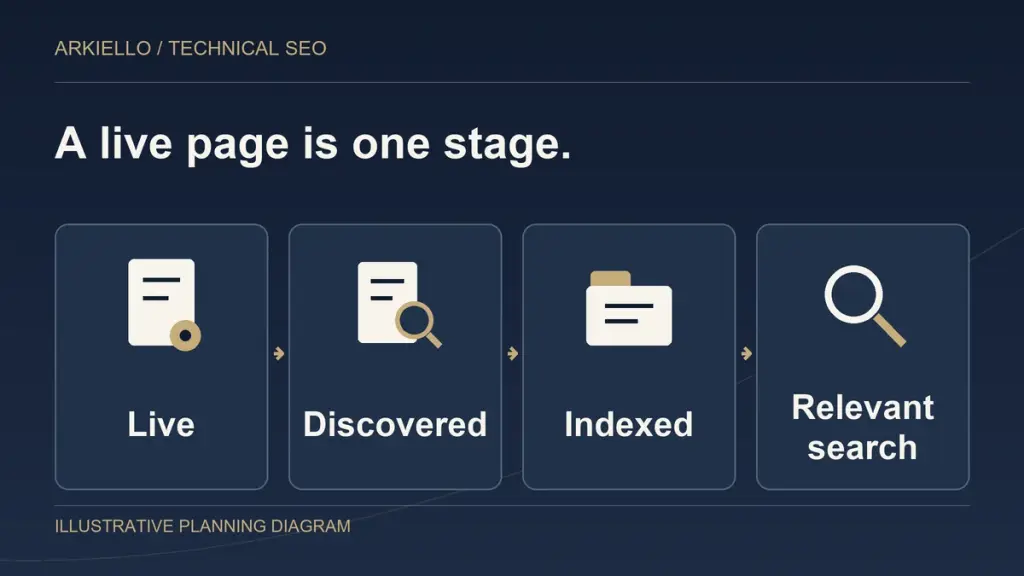
When an important page does not appear in Google, the next step depends on what is actually missing. Buying more articles, requesting indexing repeatedly or rebuilding the website can leave the original problem unresolved.
ARKIELLO’s technical SEO review and fixes starts by identifying the affected public URLs and the evidence behind the concern. That gives a business owner a clearer basis for deciding what work to commission.
Separate the stages before choosing a repair
These stages describe different questions:
- Published: has the page been saved with public visibility in the website system?
- Live: does the intended public address serve the right page?
- Discoverable: can visitors reach it through useful website links?
- Crawled: has Google fetched that URL?
- Indexed: has Google included the page in its search index?
- Ranking: does the page appear for the searches that matter to the business?
- Enquiry: do suitable visitors understand the offer and take the next step?
A published page can be absent from a static export. A live article can be missing from the blog listing. An indexed service page can appear poorly for a competitive query. Each situation needs a different investigation.
Record the concern in a form someone can investigate
Before changing settings, record the exact public URL, the date you checked it and what you expected to happen. If the concern is a particular search, include that query and the intended audience or location.
For example, an owner might say, “Our public service page loads when I open its address, but I cannot find it for the service name.” That is a starting observation, not proof that Google has excluded the page.
If Search Console access is available, preserve the relevant report, its last crawl date and any recent website changes. Say whether the page should be indexed at all. Do not send customer records or passwords in an initial enquiry.
Compare Google’s record with the current public page
Google’s URL Inspection tool distinguishes its indexed record from a live test. A report can describe an earlier crawl, while the website has already changed. A successful live test checks potential indexability; it does not establish that Google has indexed the page or selected it as canonical.
Review the reported status, crawl information and canonical selection together. A duplicate URL pointing to an intended primary version can be correct. “URL is on Google” also does not promise a particular position for the search you tried.
Those distinctions help avoid paying to fix the wrong version of a page or treating an old report as evidence that a recent change failed.
Follow the evidence to the right type of work
If the public address is broken, serves the wrong content or was omitted from the release, investigate publication and deployment first. Search Console cannot repair an incomplete website export.
If the address works but important pages are absent from website listings, inspect the visitor route. Our guide to published pages missing from website navigation explains that separate discovery problem.
If an intended public page has a blocking instruction or an unexpected canonical, agree the desired behaviour before changing it. For problems introduced during a replacement website, the redesign SEO checklist provides broader launch context.
Once an appropriate change is live, Google’s recrawl guidance covers URL Inspection requests for a few pages and sitemaps for larger sets. A submitted request is not confirmed indexing. Repeating it does not speed crawling.
Keep intentional exclusions intact
Do not remove every noindex instruction or canonical simply to make a report look cleaner. Review-only work, private client material, duplicate versions and other deliberately excluded pages need their intended treatment preserved.
Noindex controls search visibility; it does not secure confidential content. Any access-control concern requires its own decision. An investigation should identify the intended public page and the reason for an exclusion before recommending a change.
Recognise when the next question is ranking or enquiries
If the intended page is indexed, investigate its relevance to the query, the offer it explains and its role among other pages. That may require content and service positioning work alongside the wider SEO plan.
If suitable visitors already arrive but do not enquire, examine the next step they are offered. More indexing requests will not clarify an uncertain service or a difficult contact journey.
Commission a diagnosis with a clear next decision
Ask for the affected URLs, evidence dates, intended behaviour, recommended actions and responsibilities. Agree whether the engagement includes implementation and checks after release. Our audit report versus implemented fixes guide explains that scope decision.
Start with the right investigation
Discuss your technical SEO priorities with ARKIELLO. Send your website, the affected public URLs and what you expected people to find. We can investigate the concern and agree which fixes deserve attention.