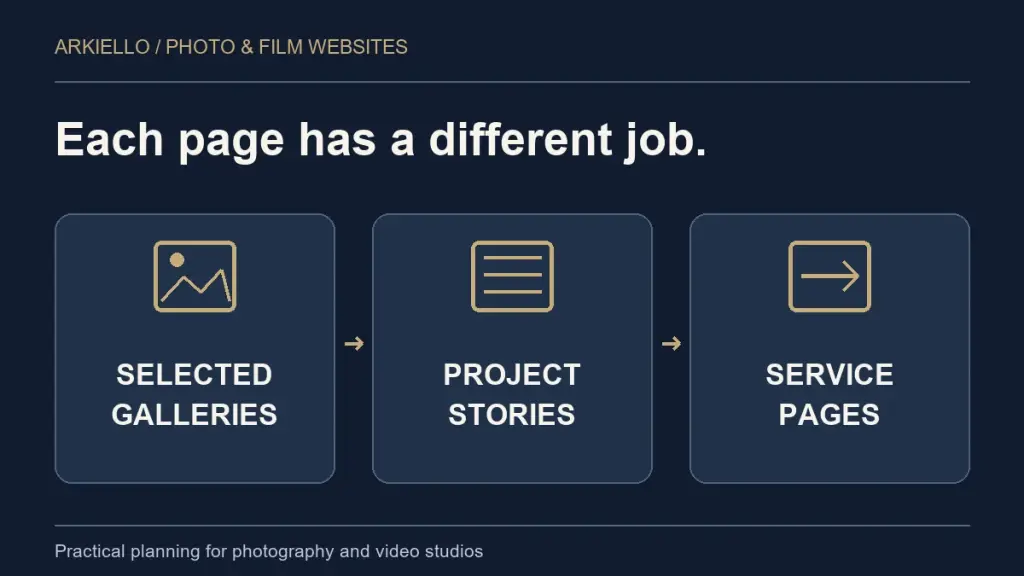
A photography website needs to help someone judge both your work and whether they can hire you for their project. Galleries, full stories and service pages support different parts of that decision. Give each a clear purpose before deciding how many pages to build.
This guide is for photographers and photo/video studio owners planning a website. Our photography and videography website design and SEO service connects portfolio structure with service information, search foundations and the enquiry journey.
Give each page a job
A selected gallery introduces the work quickly. A story or project page provides more context. A service page explains the work a prospective client can commission. A contact route collects enough information to start a useful conversation.
Those jobs can sometimes fit on fewer pages. A studio with one clearly defined service may need a simpler structure than a team offering wedding films, commercial photography and family sessions. Separate pages should help a visitor make a real distinction, rather than repeat the same offer under different headings.
Use selected galleries to establish visual fit
Choose images that represent the type of work you want to be hired for and the range a client should expect. A portfolio can show consistency across situations without publishing every delivered photograph.
Group work around a distinction your audience understands. A commercial buyer looking for product photography should not have to work through a wedding gallery to discover whether you offer it. Labels such as “commercial,” “families” or “weddings” are useful only when those are services the studio actually provides.
Consider how the selection works on a phone. A clear cover, sensible sequence and ordinary links into the work can make browsing easier than a large wall of similar thumbnails. Give people a way back to the service information and forward to an enquiry.
Use stories when the project adds useful context
A fuller story can explain the brief, setting and work delivered, where those details are accurate and approved for publication. It helps a visitor understand how the photographs or film relate to a real assignment.
For a wedding, that might mean a short account of the event and the spaces represented in the gallery. For a commercial shoot, it might explain the type of deliverables and the intended use. Avoid publishing private client information or implying an endorsement that has not been given.
Not every album needs to become an indexed story page. Keep client delivery galleries, private proofing and the public portfolio as separate planning decisions. A page intended for a specific client may need access controls, not just a setting that discourages search indexing.
Use service pages to explain the commission
A service page should answer what the studio offers, who it is for, where the work can be arranged and what happens after an enquiry. Connect that information to selected examples of the relevant work.
Useful content can include the type of session or production, important deliverables, the way a project is scoped and the next step. Be explicit when travel, editing, additional coverage or other arrangements need discussion. Your website should not imply that every possible extra is included.
Pricing can be a full package, an accurately explained starting point or a request for a tailored estimate. Our photography website pricing guide explains how to choose an approach without leaving visitors guessing what a number covers.
Connect the pages around a visitor’s decision
Imagine a studio that genuinely offers both wedding photography and commercial films. This is an illustrative structure, not a recommended page count for every business:
- A service overview helps the visitor choose the relevant type of work.
- The chosen service explains the offer and links to a few representative projects.
- A gallery or story shows relevant work and returns the visitor to service details.
- The enquiry route asks for the project type, contact information and useful timing or location details.
The visitor should not have to remember the studio’s navigation to take the next step. Add descriptive links where the next question naturally arises. Keep the labels about the work the visitor will find, rather than repeating “click here.”
Give photographs and films useful page context
Images should sit beside information that helps a visitor understand what they show. Use appropriate image descriptions and alt text without adding unrelated locations or keyword lists. Google’s image SEO guidance explains the role of page context and accessible image descriptions.
Prepare images for the layout and check the actual page on a phone. File preparation, image dimensions and loading behaviour are technical decisions that should support the viewing experience; simply uploading the largest original is not a website strategy.
Film browsing has a related distinction. A film library helps people find work. A dedicated film page can give an individual production its own description and viewing space. The need for those pages depends on the portfolio and search objectives. A link to a film on another platform is not automatically a video watch page on your own website.
Plan the structure before requesting a redesign
Inventory your current services, public portfolio, client galleries, films and useful existing URLs. Decide what needs to stay, what can be curated and what should remain private. In the Shuttersteve redesign case, the review-preview scope includes galleries, film content and migration planning. The case is evidence of project scope, rather than a promise of search results.
The MCT Productions public preview provides another example of photo collections and a separate film library; the project is described as in development. Use examples to make a brief more concrete, rather than assume the same layout or platform suits every studio.
Turn the portfolio into a useful website brief
Our photography website quote guide helps you compare the work involved. To discuss your own structure, send ARKIELLO your website URL, services and a few representative galleries or films. We can plan the pages and enquiry route around those requirements.