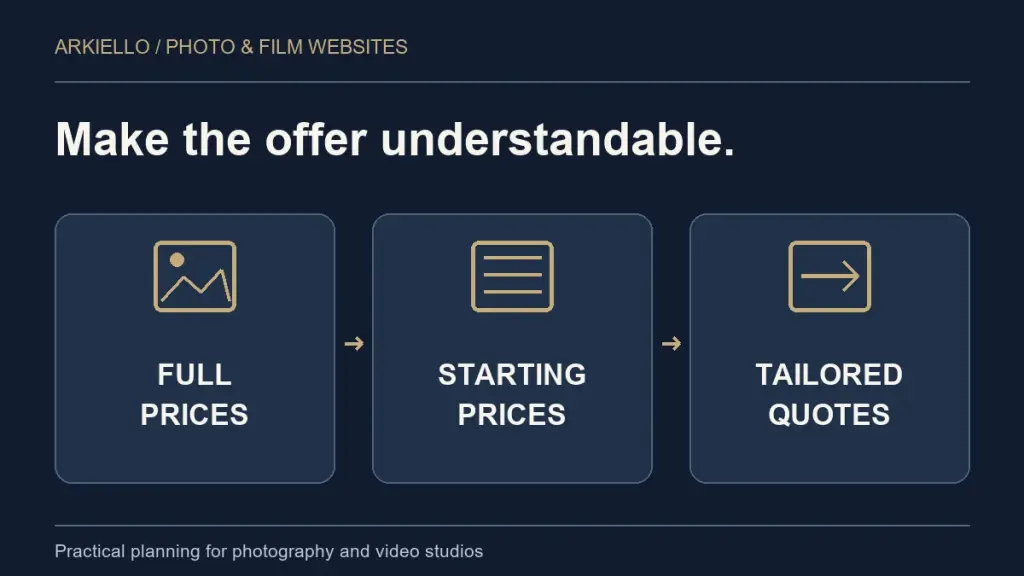
Showing prices can help a prospective client decide whether to enquire, but the right presentation depends on how your photography or film services are sold. A repeatable session and a production with several locations do not need the same pricing page.
The website should make the offer understandable before asking someone to contact you. Our website design and SEO guide for photographers and videographers connects pricing information with the portfolio, service pages and enquiry process.
Start with the information you can stand behind
Before choosing a price format, list what is consistent and what changes between projects. Consider coverage time, team size, location, travel, editing, deliverables, turnaround options and any additional requirements. Separate your standard service from optional additions.
Then ask which details a visitor needs to assess fit. You may not be able to publish a final total for every job, but you can explain what the quote depends on. A page that only says “contact us for pricing” leaves the reader to discover every condition through a conversation.
Publish full prices when the service has a clear scope
Full prices suit an offer you can describe consistently and keep current. A visitor should understand what the displayed price buys without having to interpret several different pages.
Place the essential information beside the amount:
- The type of session or assignment covered.
- The time, location or coverage limits.
- The photographs, films or other deliverables included.
- Important exclusions and optional additions.
- Any relevant conditions that affect the displayed total.
Do not turn every possible combination into a package card. If the options require lengthy explanations, a simple comparison followed by a tailored enquiry may be easier to use. Clear service descriptions matter more than the number of pricing tiers.
Use starting prices when there is a real starting service
A starting price is useful when it refers to an actual service someone can reasonably book. Explain that service and the main reasons a final quote could be higher.
Avoid displaying a low headline amount while placing unavoidable additions elsewhere. The point is to establish a useful starting expectation. If almost every suitable enquiry requires a different scope, explain that scope rather than relying on a misleading entry figure.
A clearly hypothetical example: one studio offers a shorter weekday portrait session with a defined image selection. Another offer includes extended coverage, a second photographer and a larger edited collection. Calling both simply “photography from…” hides the difference. Naming each offer and its limits helps visitors understand what they are comparing, even before discussing the actual amounts.
Use tailored quotes when the work genuinely varies
A custom quote can be appropriate for multi-location films, mixed photography and video assignments, or projects with different production requirements. Explain what information is needed and why it changes the scope.
For example, ask about the service, preferred date, location and approximate coverage. A commercial project may also need a short description of where the work will be used. Leave detailed production planning for the next conversation.
The page can still identify the deliverables your team normally discusses, how a proposal is prepared and what a visitor should send. Avoid promising an instant or fixed-time quote unless the business actually supports it.
Put pricing where it helps a decision
A separate pricing page is optional. A concise section on a service page may answer the question more naturally, especially when different services have different inclusions.
Connect the explanation to relevant work. A wedding film collection, for example, should lead to the film service and its enquiry route. It should not send visitors through unrelated portrait packages. Our photography portfolio website structure guide explains how galleries, stories and services can work together.
On a phone, check whether package comparisons remain readable and whether the contact button sits near the useful details. Keep essential inclusions in readable page text rather than only in a downloadable image.
Include pricing responsibilities in the website brief
Agree who approves the copy, updates amounts and checks linked documents. Ask for an editing approach your team can maintain. A price repeated across several pages needs a clear owner and a reliable update process.
When commissioning the website, identify which service pages need pricing sections, which need comparisons and which need tailored enquiry fields. Our photography website design quote guide helps turn those requirements into deliverables you can compare.
Plan clearer pricing information
Discuss your photography or videography website with ARKIELLO. Send your website, the services you offer and the questions people ask about pricing. We can discuss how the pages, portfolio links and enquiry form should explain your offer.