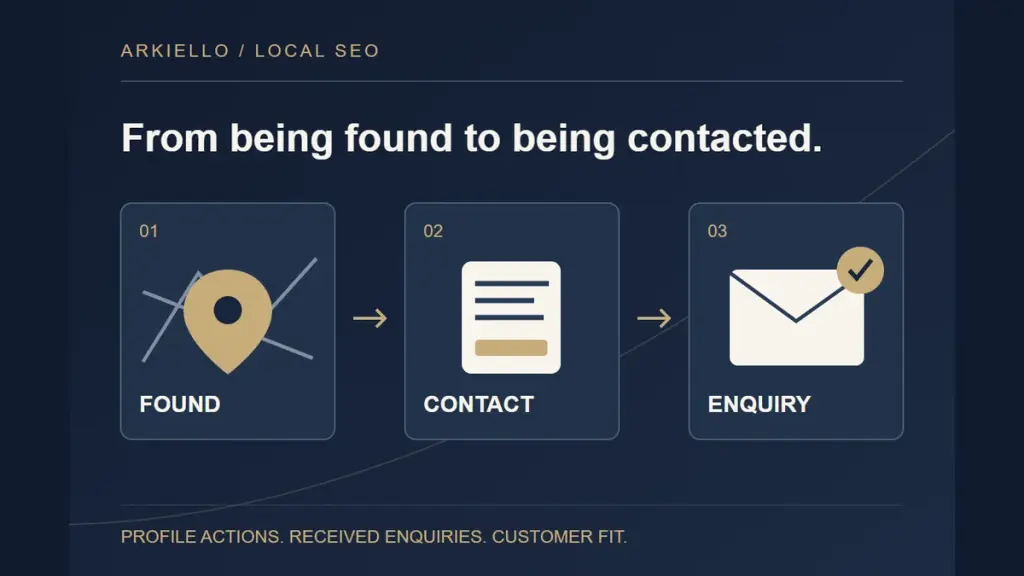
Your business appears on Google Maps, but the phone is quiet or the enquiries rarely match the work you want. Before paying for more visibility, look at what happens between someone discovering your profile and your team having a useful conversation.
The problem could be the information people see, the page they reach, the contact route or the way your business handles the response. Our local SEO service brings those parts into the same review so the next decision addresses a specific concern.
Start by separating attention from enquiries
Google Business Profile performance reports can show interactions such as calls and website clicks. Google defines its calls metric as clicks on the profile’s call button. It does not establish that someone answered or that the caller became a customer. Website clicks count clicks on the profile’s website link, rather than completed enquiries. Available metrics vary by business and profile. See Google’s Business Profile performance definitions when reviewing your numbers.
Keep these stages separate:
- Discovery: someone encounters your business on Maps or Search.
- Contact action: they click through to your website or use a contact option.
- Received enquiry: your team receives a real request and can respond.
- Qualified enquiry: the service, location, timing and requirements fit the work you can provide.
- Booking or sale: both sides agree to proceed.
A high number at one stage does not prove the next stage happened. Identify the gap before choosing a fix.
Does the profile help the right customer choose?
Read the profile as someone who has never heard of your business. Can they understand what you do, where you work and how to reach you?
Check the service information, current opening hours, phone number, website destination and photographs. Compare them with your actual operation. Use our Google Business Profile checklist to organise the review.
Search visibility is a separate question. Google describes local results as primarily influenced by relevance, distance and prominence. A useful review considers the search being made and the searcher’s location, rather than treating every Maps appearance as equal. Read Google’s explanation of local ranking factors.
If the profile attracts requests for services you do not offer, clarify the offer before trying to attract more of the same traffic.
Where does the website link take people?
Follow the profile’s website link on your own phone. Does the destination continue the conversation started by the profile?
A hypothetical example: someone looking for home support in a particular service area reaches a homepage that describes a broad company mission. They still cannot tell whether the team covers their location or provides the support they need. The missing information creates another task before they can enquire.
A useful destination answers four practical questions:
- Is this the service I need?
- Does the business cover my location?
- What should I understand before asking?
- What happens when I make contact?
Choose the destination around the real customer journey. Our guide to service pages and location pages explains when each has a useful role. If visitors already reach your site but stop there, review our website visits but few enquiries guide for the wider website checks.
Check the contact route with your team
Arrange one agreed test rather than assuming a visible button means everything works. Check the number on a phone, the form on mobile and where the message arrives. Confirm that someone recognises and handles the test.
Look beyond technical delivery. Who answers during working hours? Who follows up when a call is missed? Does the confirmation message tell visitors what to expect? Can the team respond to the type of request the profile invites?
Use honest response expectations based on your team’s capacity. Avoid promising an immediate callback if nobody can reliably provide it.
Keep a small lead log
You do not need a complicated dashboard to begin learning from enquiries. Record enough to distinguish discovery activity from the requests your team actually receives.
- Date and contact method.
- How the person says they found you, with “unknown” when unclear.
- Service requested and relevant location.
- Whether someone responded and the next action.
- Whether the request fitted your services, with a short reason.
- Outcome when it becomes known.
Use broad categories rather than copying sensitive customer details into a shared marketing sheet. A customer’s recollection can help, but it is not precise attribution. Someone may discover you on Maps, return directly to your website later and call after a recommendation.
Improve the weakest step first
Review the log alongside profile activity over a consistent period. Account for changes in opening hours, staffing and demand. Use the comparison to form a practical question, rather than declaring that one number explains everything.
For example, if your hypothetical log shows repeated missed calls, improve the response process and review what happens. If requests repeatedly concern an unserved location, clarify coverage. If visitors ask basic questions the destination page should answer, improve that page.
Change one clear priority at a time where practical, and record when it changed. This gives your team a more useful basis for the next decision than repeatedly changing several things without a record.
Ask for a review with a clear scope
Before accepting a proposal, ask how the provider will review the profile, website destination, contact route and enquiry quality. Confirm what they need from your team and how they will report the work. Our local SEO proposal guide helps you compare that scope.
Request a local SEO and enquiry review. Send your website, Google Business Profile link, service area and the concern you want to solve. Tell us whether the main issue is being discovered, getting contacted or receiving requests that fit your business.