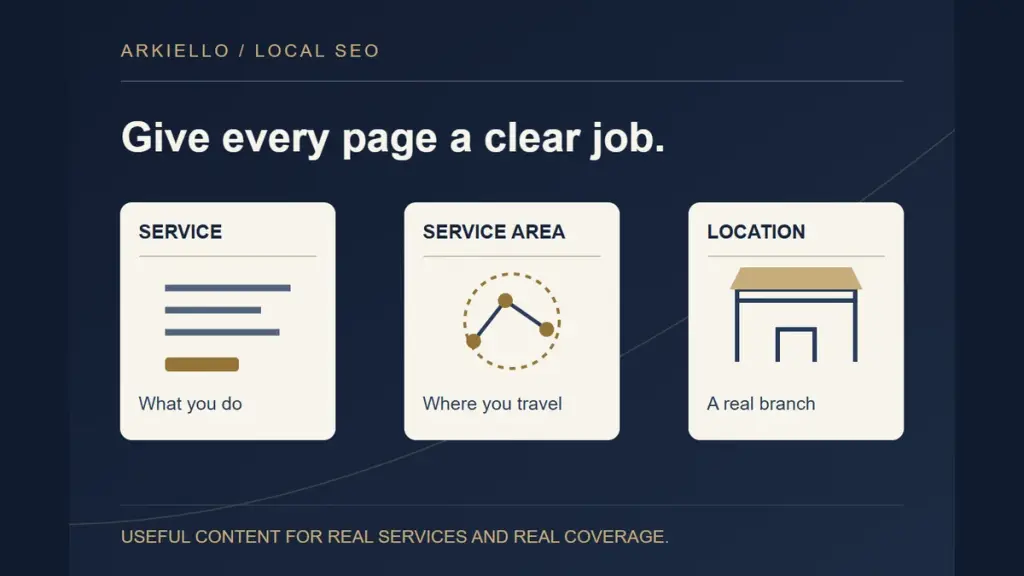
A service page explains what you do. A location page explains a real business location. A service-area page helps someone understand whether and how you can serve their area. They can work together, but a business rarely needs every possible combination of service and town.
Before commissioning more pages, decide what each one will help a potential customer do. ARKIELLO’s local SEO service connects useful website content with accurate business information and a clear enquiry path. The right structure starts with the work you offer and the places you genuinely cover.
Three page types, three different jobs
Service pages explain the offer
A service page helps a visitor decide whether a particular service fits their need. Explain what the work includes, who it suits, relevant limits, how the process works and what information you need to prepare a useful reply.
For a cleaning business, an end-of-tenancy cleaning page should explain that service. It can link to coverage information without repeating the same description across fifteen towns. Photographs, practical preparation advice and clear exclusions can make the offer easier to evaluate.
Branch or location pages explain a real place
A branch page helps customers visit or contact a specific operating location. Useful details may include its actual address, opening hours, contact route, services available there, arrival information and accessibility facts the business has checked.
A company with one office does not need to imply it has branches elsewhere. A city named in a heading is not evidence of a physical location. Give visitors accurate information about where they can meet the business and whether visits require an appointment.
Service-area pages explain genuine coverage
A service-area page can help someone understand how a business serves their town or region without suggesting an office exists there. Explain the available services, any coverage boundaries, how work is arranged and relevant questions customers in that area ask.
The page needs enough substance to justify a separate destination. If the offer and practical information are identical everywhere, a clear coverage section on the main service page may answer the question more efficiently.
Use a small hierarchy before building a large one
Consider a hypothetical cleaning company with one customer-facing branch and teams that also travel to nearby towns. This is an illustration of page roles, not a claim about an ARKIELLO client.
- Services: a short introduction linking to end-of-tenancy cleaning and office cleaning.
- End-of-tenancy cleaning: scope, preparation, exclusions and the quotation process.
- Office cleaning: suitable premises, working arrangements and the enquiry process.
- Visit our branch: the actual location, hours and visitor information.
- Areas we serve: an honest coverage overview, with links to any area pages that provide additional useful detail.
- Contact: one clear route for sending the service required, location and preferred timing.
This structure lets a visitor move from the service to coverage and then to an enquiry. Additional pages should resolve a real gap. They should not be added simply because a spreadsheet contains another town name.
Decide whether an area deserves its own page
Before creating a separate area page, ask:
- Do we genuinely offer the stated service there?
- Does this audience need information the existing page does not answer?
- Can our team provide accurate local details or relevant approved examples?
- Will the page help a customer choose or prepare an enquiry?
- Can we maintain it when coverage or services change?
Useful differences might include the services available, how visits are arranged or a checked coverage limitation. Do not invent local distinctions to fill a template. When there is little to add, improve the existing service or coverage page first.
Fewer useful pages can be the better investment
A service-by-town plan can multiply quickly. Five services across twelve towns would create sixty proposed combinations before anyone has established that visitors need them. Each page also needs writing, approval, links and ongoing maintenance.
Google’s doorway abuse policy includes pages targeting similar searches that funnel visitors onward without useful independent value. This does not make every area page a problem. The concern is the purpose and usefulness of the pages, including sets of near-identical city pages.
Start with the pages that best explain your main services. Add coverage detail where it helps. Review enquiries and available search data before expanding the structure. More published URLs are not, by themselves, a useful business outcome.
Website pages do not create Business Profile eligibility
Publishing a town page does not establish a branch or entitlement to another Google Business Profile. Google’s business representation guidelines set requirements for real locations and service-area businesses. A virtual office alone does not qualify. Keep website descriptions consistent with how the business actually operates.
See the structure as part of a wider project
Our Avelora Life project included a website revamp and ten Alberta city pages, alongside Google Business Profile, Maps, Analytics and Search Console work for an international client in Canada. It shows a combination of service information, local content and search setup. It does not establish that ten pages are right for every business or demonstrate a particular ranking or enquiry result.
If people already find the business but rarely contact it, use our guide to Google Maps visibility with few enquiries before commissioning more content. If you are comparing suppliers, our local SEO proposal guide explains how to agree page scope and responsibilities.
Plan the pages your customers need
Send your website URL, main services and real coverage areas. We can discuss which existing pages to improve and where a separate page would be useful. Discuss your local website structure.