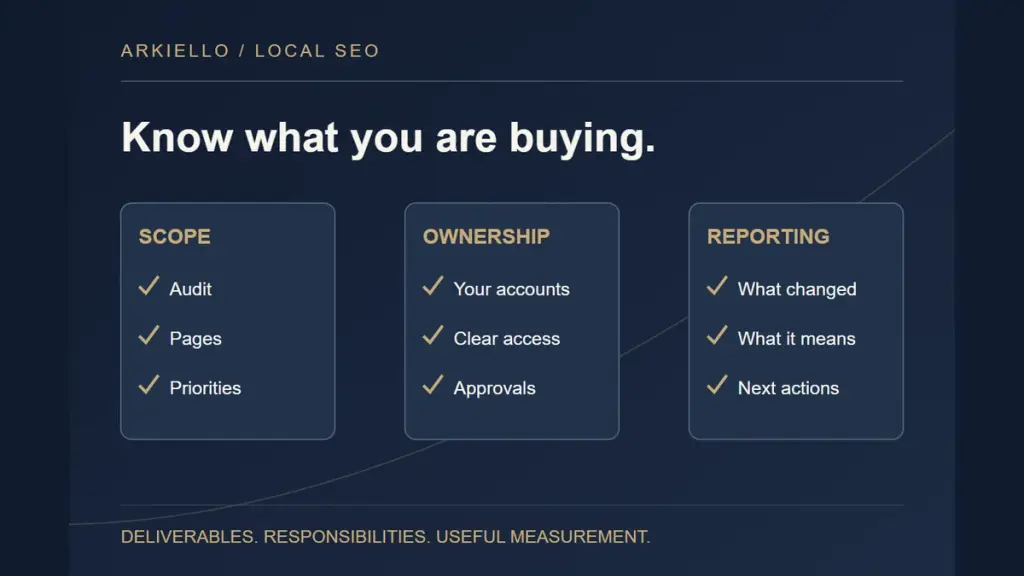
The most useful local SEO proposal makes the work understandable before you buy it. You should be able to identify what will change, who will do it, what your team must supply and how progress will be reviewed. Compare those commitments before comparing monthly fees.
Start with your business and the problem
Ask the provider to describe your business model, priority services, real operating locations and current enquiry problem. A shop receiving visitors needs a different plan from a company travelling to customers. State which services you want to grow and where you can realistically deliver them.
Profile work must reflect the actual business, address and service area, with eligibility checked before setup. See Google’s business representation guidelines.
The initial assessment should identify access gaps, existing pages, profile issues and measurement limitations. Ask whether it delivers recommendations, implementation or both. Our local SEO service overview explains how profile and website work fit together.
Turn broad promises into named deliverables
“Monthly optimisation” does not explain what you receive. Request a task list with deliverables you can inspect:
- Profile work: the details being reviewed, proposed corrections, supporting photos needed and the approval process.
- Website work: named pages, contact routes, internal links and technical issues included in the scope.
- Content work: specific page topics, the questions they answer, who writes them and how revisions are handled.
- Measurement work: which enquiry actions will be checked, what tracking will be configured and how it will be validated.
Distinguish editing existing pages from creating new ones. A plan covering three service-page improvements is different from one promising unspecified content each month. Read how service pages and location pages serve different purposes before agreeing to a page list.
If problems require development, ask whether technical SEO assessment and fixes are included or separately quoted.
Keep account ownership and access clear
Your business should retain ownership of its domain, website, Business Profile and measurement accounts. The proposal should identify the access needed for each task, who grants it and who can remove it. Invite the provider through appropriate account roles, such as manager access where suitable, rather than sharing your personal password.
An access inventory also helps uncover accounts controlled by a previous supplier. Ask who will resolve those gaps and whether recovery work requires separate approval. Establish where approved copy, images and reports will be stored.
Agree on your team’s responsibilities
Decide who confirms services, coverage, opening arrangements, phone numbers and customer-facing claims. Name one person who can approve changes and a backup contact if that person is unavailable.
Clarify who supplies photography, obtains permission to use customer material and checks draft pages for accuracy. Set a review period and explain what happens when approvals arrive late. The schedule should distinguish work awaiting your input from work ready for the provider to complete.
Define reporting around enquiries
Request a starting point and a report that separates work completed, visibility signals, website actions and genuine enquiries. Agree what a qualified enquiry means for your business, such as a request for an offered service within your coverage area.
Google’s Business Profile calls metric records clicks on its call button, rather than confirmed answered conversations. See Google’s performance metric definitions.
Your team may need to reconcile recorded actions with actual conversations and outcomes. Ask who records enquiry quality and how duplicate contacts will be handled. Avoid treating every button click as a new customer. Our guide to Google Maps visibility with few enquiries explains where the journey can break down.
Separate initial work from ongoing support
A defined setup project might cover an assessment, agreed corrections, selected page improvements and measurement checks. Ongoing work should describe what continues after that project: reviewing changes, addressing new priorities, maintaining approved information or developing agreed content.
Ask what a typical monthly review produces and whether unfinished tasks carry forward. Confirm the minimum commitment, renewal arrangements, cancellation terms and responsibility for work already approved. A recurring fee should have a recurring purpose you understand.
Compare costs alongside exclusions
Scope can change with the number of locations, pages needing attention, existing account problems, content requirements and technical condition of the website. Ask which assumptions the quote uses and what would trigger an additional estimate.
List exclusions explicitly. These may include advertising spend, photography, hosting, paid software, major website development, translation or profile recovery. Identify third-party subscriptions and who pays for them. Clarify taxes, payment stages and whether a larger content request replaces planned work or adds to the fee.
Set checkpoints and a useful handoff
Agree on checkpoints for the initial findings, approval of proposed changes, implementation review and the next set of priorities. Ask for a change record showing what was edited and where. Where results are unclear, the review should explain the evidence and the next decision.
The exit plan should cover account access, finished assets, outstanding tasks and tracking documentation. Your next supplier should be able to understand the work without reconstructing it from invoices.
Request a proposal you can make a decision on
Send the same brief to each provider: your website, profile, priority services, operating areas and main concern. Ask each to return a defined initial scope, ongoing responsibilities, reporting plan and exclusions.
Google advises asking providers to explain their changes and cautions against guaranteed first-place rankings. Use its guidance on choosing an SEO when assessing promises. Google also identifies relevance, distance and popularity as important local ranking factors in its local ranking guidance.
Plan the work before committing
Tell ARKIELLO about your local SEO project. Include your website, Business Profile link if available, priority service and the area you serve. We can discuss what needs investigation and define a suitable scope. Rankings and enquiry volumes are not guaranteed.