Search for “dentist near me” or “plumber in Brampton” and Google shows a map with a handful of businesses before any ordinary search results. Being in that group, often called the local pack, can bring more calls than everything else on your website combined.
Google is unusually open about how it chooses those businesses. This guide explains the three factors it names, what you can and can’t influence, and where to start. It’s the thinking behind our local SEO service.
The three factors Google uses
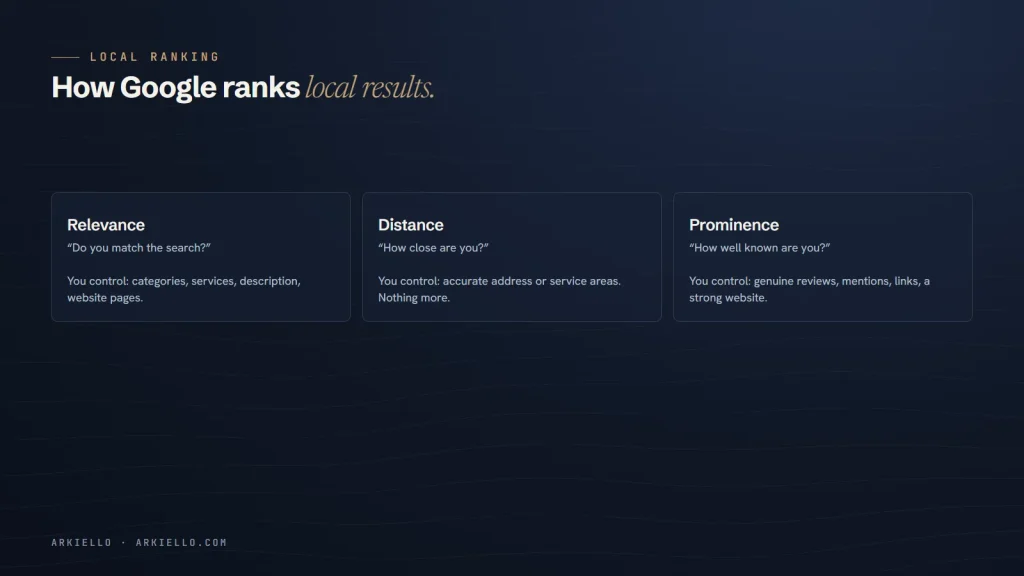
Google’s own help page on how local results are ranked says they are based mainly on relevance, distance and prominence, used in combination. A business that is farther away can still outrank a closer one if Google thinks it is a better match for the search.
Relevance: do you match the search?
Relevance is how well your business matches what someone is looking for. Google reads it from your Business Profile, especially your categories, services and description, and from your website.
What you can do: choose the most specific primary category, list every service you genuinely offer, and make sure your website has a clear page for each main service. Our Google Business Profile checklist covers each of these settings.
Distance: how close are you?
Distance is how far your business is from the location in the search, or from the searcher if they didn’t name a place. This is why results change as you move around a city.
What you can do: very little directly, and that’s fine. Don’t invent addresses or rent virtual offices to appear closer to more customers; Google’s guidelines don’t allow it and such listings are often removed. If you serve customers at their location, set your service areas accurately instead.
Prominence: how well known are you?
Prominence is how well known and trusted your business is. Google says it is based on information from across the web, such as links, articles and directory listings, along with your review count and ratings. Google also notes that your position in regular web results counts, so standard SEO work on your website helps your local visibility too.
What you can do: build a steady flow of genuine reviews, reply to them, earn mentions from local organisations, suppliers and press, and keep your website fast and useful. Our guide on how to get more Google reviews the right way covers the first two.
What doesn’t work, and what can hurt
Some tactics still circulate because they once seemed to work. Most of them now risk a suspended profile:
- Keywords in your business name. Adding services or cities to your name goes against Google’s guidelines and invites suspension.
- Fake or virtual addresses. A profile must represent a real location where you meet customers, or be set up as a service-area business.
- Bought or incentivised reviews. They break Google’s policies and, in many countries, consumer protection law.
- Copy-paste city pages. Dozens of near-identical pages that only swap the town name rarely help and make your website weaker.
- Paying Google for a better position. Google states that there is no way to pay for a better local ranking. Ads appear separately and are labelled as sponsored.
Why your customers see different results
If you search for your own business from your office, you will probably see yourself near the top, because you are standing next to it. A customer across town sees a different list. Results also vary by device, by the exact words used and by what Google knows about the searcher.
To get an honest picture, check results from the areas where your customers are, or use a local rank-tracking tool that checks a grid of points across your service area. Track the trend over months rather than reacting to a single search.
Your website’s role in local rankings
Your website feeds all three factors. Clear service pages add relevance. Consistent contact details confirm where you are. And because regular search rankings contribute to prominence, technical health matters too: fast mobile pages, clean indexing and helpful content.
Two website details are worth checking straight away. First, make sure your business name, address and phone number on the website match your profile exactly. Second, add LocalBusiness structured data, which states those details in a format search engines read reliably. Our technical SEO service covers both.
Where to start
If you are starting from scratch, work in this order:
- Claim, verify and fully complete your Business Profile.
- Choose the right primary and additional categories.
- Make your name, address and phone consistent on your website and main directories.
- Start asking every happy customer for a review, and reply to each one.
- Build or improve a clear page on your website for each main service and area.
- Measure calls, direction requests and website visits every month.
Not sure where you stand?
We’ll check how your business appears for a key local search and tell you what to fix first. Get a free local SEO check, or see how our local SEO service works.