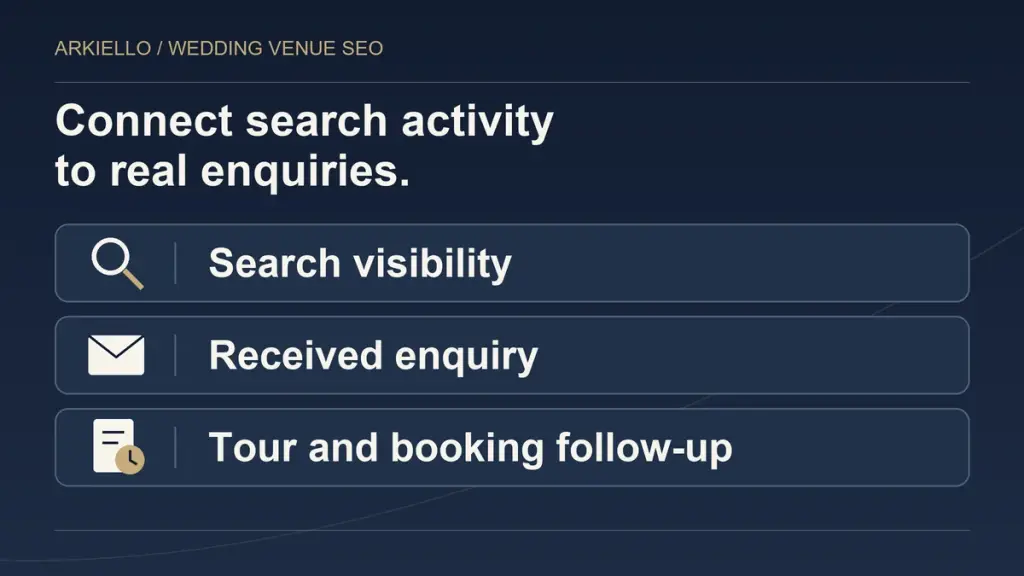
A wedding venue SEO report should help you decide what to improve next. More impressions, a better average position or additional website visits can be useful signals, but they do not tell your team whether suitable couples asked about a date or arranged a tour.
Before commissioning the work, agree how search activity, received enquiries and venue follow-up will be recorded. Our wedding venue SEO service connects discovery and page improvements with that reporting scope. Start with definitions your marketing and events teams can both use.
Give each stage a clear meaning
A single total called “conversions” can hide several different actions. Write down the stages that matter to your venue and the evidence needed for each one:
- Search visibility: the venue’s pages appear for relevant searches. This is exposure, not a contact request.
- Website visit: someone reaches a page. They may still be researching or comparing locations.
- Date or package enquiry: a request is successfully submitted through an agreed route and reaches the receiving system or team.
- Suitable enquiry: the venue team confirms that the request fits the actual offer, such as event type, guest requirements and availability discussions.
- Confirmed tour: the team and couple agree to a visit. Clicking a tour button or asking for a visit is an earlier stage.
- Venue-confirmed booking: the business records a booking under its own approval and payment process.
These are suggested business definitions, not automatic labels supplied by an analytics installation. Agree which stages you can verify and who records them. A useful report can show an unmeasured stage rather than attach a confident number to an assumption.
Use search reporting to investigate the right questions
Google’s Search Console Performance report provides clicks, impressions, click-through rate and average position, with views such as queries and pages. Use that information to investigate whether the pages are being found for the venue’s actual offer.
Separate searches for your venue name from broader discovery themes where the available data permits. Look at relevant landing pages alongside the questions couples ask. A package page receiving visits and a location guide appearing in search have different roles; neither should be judged only by the whole site’s traffic total.
Our wedding venue location-page guide helps distinguish the real venue address from the places couples may travel from. The package-page guide helps assess whether visitors can understand the offer after arriving.
Check what the website event actually records
Ask the provider to demonstrate the agreed action. Does the event fire when someone opens the form, clicks Submit or receives a successful submission response? What happens if a required field is missing or delivery fails?
Google documents a generate_lead event for lead generation, for example through a form. Choosing that name does not verify the implementation or qualify the enquiry. The trigger, receiving destination and business definition still need checking.
Agree an authorised test with the receiving team. Confirm that the request arrives, the event means what the report says it means and a single submission is not counted repeatedly. If the website sends people to an external booking system or messaging service, define which part of the journey can be observed and which depends on that provider or the venue team.
Reconcile enquiries with the venue team’s records
The events team knows what happened after first contact. Agree a practical way to record the enquiry date, entry route where known, relevant requirements, follow-up stage and outcome. Keep customer contact details in the approved business system, separate from the marketing summary.
Some attribution will be incomplete. A couple may discover the venue in search, return through a saved link and later contact your team elsewhere. Record “unknown” where evidence is missing. Do not force every booking into the last visible website event or assume that every enquiry followed an organic search visit.
A compact review can compare received requests with the corresponding follow-up stages. Investigate missing messages, duplicated events and inconsistent staff records before using those totals to decide where to spend more.
Compare periods with the venue’s context
Record the reporting dates and the changes made. Advertising, wedding fairs, package updates, available dates and seasonal demand can affect enquiries alongside SEO work. Allow for the time between an initial enquiry, a tour and a booking when reading recent outcomes.
Choose a consistent review period suited to the volume you actually receive. A small sample deserves a careful explanation. An increase after an edit can suggest a question to investigate; it does not establish that the edit caused every additional request.
End the report with a decision and an owner
Ask for a short action record: the observation, the supporting evidence, the proposed change, the person responsible and the next review point. For example, if couples repeatedly ask about an unclear inclusion, the next action may be to clarify the package page rather than publish more articles.
Our venue enquiry diagnosis guide covers the wider visitor journey. Use it when reporting reveals an information or form problem rather than a discovery gap.
Agree reporting before commissioning more SEO
Discuss wedding venue SEO with ARKIELLO. Send the venue website, actual location, main concern and the reporting your team already has. Explain how date enquiries and tours are currently handled. We can define the page, tracking and review work without treating a click as a booking.