A website rarely fails all at once. It slowly falls behind: a little slower, a little harder to update, a little less convincing than the competitor down the road. Here are seven signs it’s time for a redesign, how to check each one, and when a lighter refresh will do instead.
If you decide a redesign is the right move, our website redesign service explains how to rebuild without losing the Google rankings you already have.
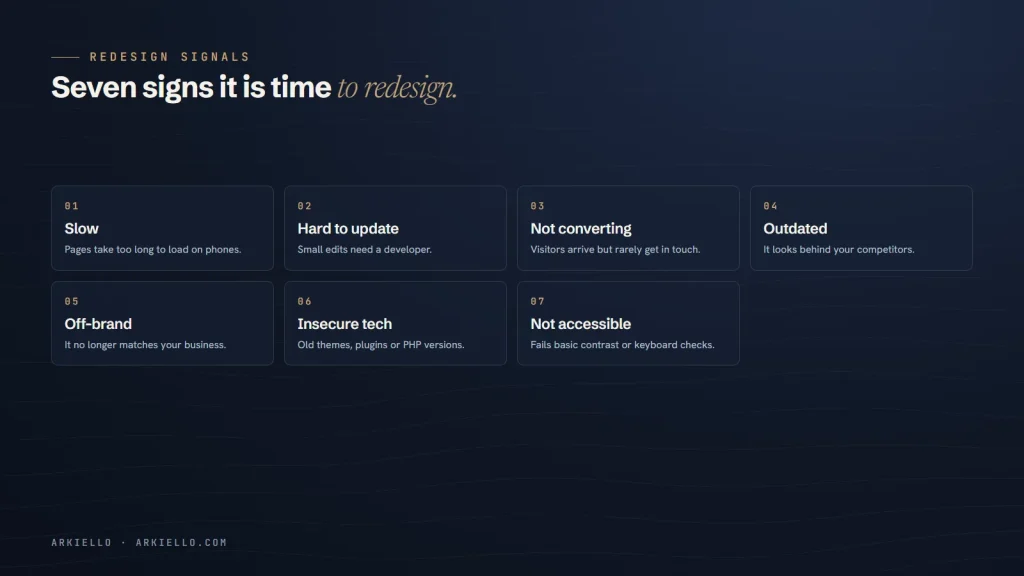
1. It’s slow, especially on phones
Most visitors now arrive on a phone, often on mobile data. If your pages take several seconds to show anything useful, many of them leave before reading a word.
How to check: open the Core Web Vitals report in Google Search Console, or run your main pages through PageSpeed Insights. Google’s Core Web Vitals documentation describes “good” as a Largest Contentful Paint within 2.5 seconds, Interaction to Next Paint within 200 milliseconds and Cumulative Layout Shift below 0.1.
2. Small changes need a developer
If updating a price, adding a team member or publishing a page means emailing a developer and waiting, your site will always be out of date. That costs trust and search visibility, because fresh, accurate content matters to visitors and to search engines.
How to check: try making a simple text change yourself. If you can’t do it in a few minutes, the platform or theme is working against you.
3. Visitors arrive but rarely get in touch
Traffic without enquiries usually means the site isn’t explaining the offer clearly, isn’t building enough trust, or makes the next step hard to find.
How to check: compare your monthly visits with your monthly enquiries from the website. Then look at your key pages on a phone: within a few seconds, is it obvious what you do, who it’s for and how to contact you?
4. It looks behind your competitors
Visitors judge credibility quickly, and design is a large part of that first impression. A site that looks a decade old suggests a business that might be too.
How to check: open your site next to your three closest competitors on a phone and a laptop. Ask someone outside your business which company they would call first, and why.
5. It no longer matches your business
Businesses change faster than websites. New services, a new market, a new brand or a new price point all deserve a site that reflects them.
How to check: read your homepage and services pages as if you were a new customer. Do they describe the business you run today, or the one you ran when the site was built?
6. It runs on outdated or insecure technology
Unsupported themes, abandoned plugins, old page builders and outdated PHP versions make a site slower, harder to maintain and more vulnerable to attacks. Eventually, updates stop being possible without breaking something.
How to check: ask whoever maintains the site which versions it runs, whether the theme and plugins are still actively updated, and when it was last fully updated.
7. It fails basic accessibility checks
Low-contrast text, images without descriptions and menus that don’t work with a keyboard exclude real customers. Accessibility expectations for business websites are also growing in several markets, including the United States and Canada.
How to check: try navigating your site using only the Tab key, and run a free accessibility checker such as WAVE on your main pages.
Refresh or full redesign?
Not every problem needs a rebuild. As a rough guide:
- One or two signs, mainly about content or visuals, can often be solved with a refresh: rewritten pages, new images and small layout changes on the current site.
- Three or more signs, or problems with speed, editing, security or structure, usually point to a redesign, because they come from the foundations rather than the surface.
Before you start the redesign
A redesign is the moment a website is most likely to lose its search traffic. Plan the protection first: work through our website redesign SEO checklist, and make sure every changed URL is covered by a 301 redirect map.
Not sure whether you need a redesign?
Send us your website and we’ll tell you honestly. Get a free redesign risk check, or see how our website redesign process works.