Home / Industries / Consultancy services
Consultancy services websites
Help the right client understand your expertise.
Website design and SEO for Tagaytay consultants and professional service firms. Make your offer understandable, show credible proof and set clear expectations for the first conversation.
Based in
Tagaytay City, Philippines
Working with
Local and international businesses
First step
An agreed website brief
Professional expertise can be difficult to judge from a website. A visitor may understand that your firm is experienced without understanding whether you handle their problem, what an engagement includes or what happens after they make contact. A useful website translates your offer into decisions a prospective client can make before the first conversation.
ARKIELLO is based in Tagaytay City and works with local and international clients. We plan website design and SEO around clear services, credible proof and a manageable enquiry process. For professional firms, the business remains responsible for approving credentials, descriptions and any statements about regulated services. We do not invent qualifications, case results or sector experience to make a page look established.
A practical website brief
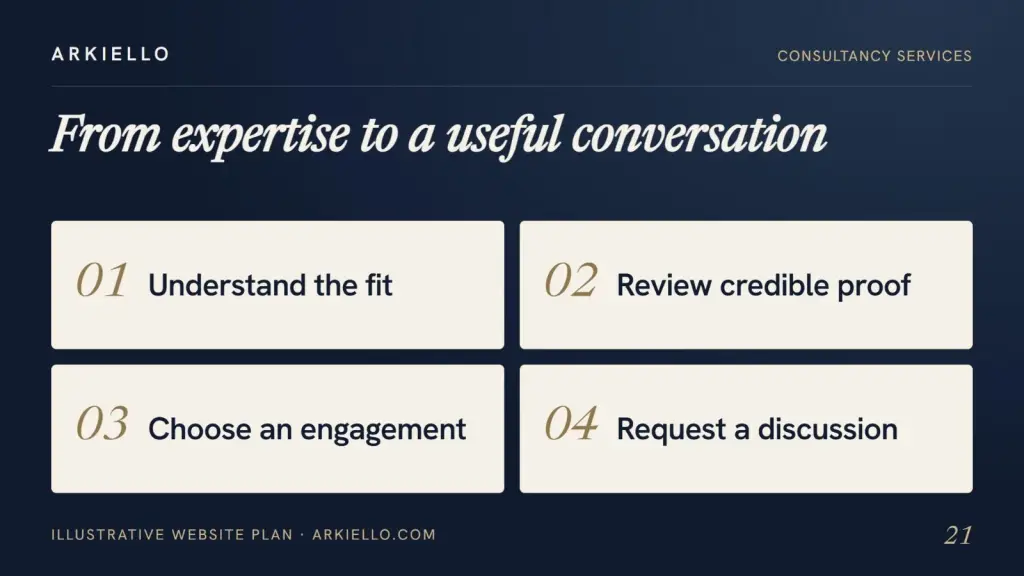
Explain the offer before asking for a consultation
Start with the client need and the work your firm actually provides. A service page should explain who it is for, the situation it addresses, the deliverables that can be commissioned and important exclusions. A broad phrase such as end-to-end advice can sound impressive while leaving the scope unclear. Give people enough context to decide whether an introductory discussion is sensible.
An illustrative business consultant might offer a defined planning project and a separate ongoing advisory arrangement. The website should distinguish those offers, including what the first discussion can establish. It should not imply that submitting a form creates an engagement or that advice is provided through a public comment. Our guide to project and retainer service pages includes a scope matrix for making those boundaries visible.
A practical website brief
Make expertise credible without overstating it
Team pages can explain relevant roles, approved qualifications and the work each person handles. Use precise wording and current information supplied by the firm. If a professional title, registration or affiliation is included, make sure the responsible person approves the description. Do not turn an association logo into an unsupported endorsement or a past role into a current credential.
Project examples can show the kind of brief you handle and the responsibility your team held. Use only approved facts, permission and context. Where confidentiality prevents identifying a client, an anonymised account may be possible, but it must still be accurate and reviewed for identifying details. The confidential case study guide helps define a practical approval process without requesting client documents through the website.
A practical website brief
Set honest expectations for the first conversation
Decide whether the first step is a general enquiry, a fit discussion, a paid consultation or a request to schedule a meeting. Use the label that matches the actual arrangement. If fees apply, the firm’s approved terms need to be understandable before a visitor commits. If no price has been published, do not imply that a form submission buys a service.
A small enquiry brief can ask for the broad service of interest, organisation or project context, contact preference and current stage. It should not invite confidential financial statements, case files, identity records or access credentials. Your team can define any later secure exchange separately. The first consultation expectations guide explains how to match the page, action label, confirmation and staff response.
A practical website brief
Build a page-and-fit matrix before design
A professional services website brief is easier to review when each page has a distinct purpose. We recommend a working sheet containing:
- The audience and problem a service page is intended to address.
- The engagement type, deliverables and exclusions approved by the firm.
- Relevant team information and proof that may be published.
- The information needed to decide whether an enquiry is suitable.
- The next step offered and the person responsible for responding.
- The reviewer for changes to credentials, services and contact arrangements.
This matrix becomes a concrete scope for website design and development. It also shows which content is missing before visual work begins. The site may start with a focused set of services and grow as the firm develops reviewed material. There is little value in launching a large library of pages that all describe the same broad offer.
A practical website brief
Use local SEO to connect a real need with the right page
Tagaytay can be part of your actual business context, operating arrangements and approved contact information. It should not be inserted into every sentence or used to imply offices that do not exist. If you meet clients in person or serve them remotely, explain the arrangement accurately. A prospective client needs to know how the relationship works, not just where a keyword appears.
Our local SEO service reviews useful page structure, search presentation and appropriate business information. Google explains that local results depend on relevance, distance and prominence. We do not promise a particular position. Review real search queries and enquiry records to learn whether visitors are reaching suitable services, rather than treating every contact click as a new client.
A practical website brief
Commission a website your team can keep accurate
A reviewable proposal should specify the page list, copy responsibilities, approval stages, form routing, responsive checks and handover. A client portal, document signing system, payment arrangement or account area should be scoped separately when there is a real operational requirement. Website presence alone does not establish that those processes are included or appropriate.
If your professional firm needs a clearer offer or a more useful enquiry journey, send ARKIELLO the public website, service list and kind of client conversation you want to attract. Keep the initial message at business level. We can plan the website structure and content responsibilities without receiving confidential client material or making claims about your professional results.
Three decisions before you commission
Plan the next step with confidence.
Questions before the project
Agree what the website needs to do.
Can you write our professional service descriptions?
ARKIELLO can help structure and write website content from the firm’s approved information. The responsible business or professional reviewer must approve credentials, service scope and any regulated claims before publication.
Do we need to publish a consultation price?
The appropriate presentation depends on the firm’s real offer. The website should accurately distinguish a general enquiry, a fit discussion and a paid service, with approved fees or terms presented where relevant.
Can a case study stay anonymous?
An anonymised case study can be considered when the firm has permission to publish the approved information and checks that the remaining details do not identify a confidential client. Anonymity does not justify inventing facts or outcomes.
What should an initial website enquiry contain?
A public website address, the broad service or project need and a contact preference are useful starting points. Keep confidential client files, financial records, identity documents and passwords out of an initial website message.
Work with ARKIELLO
Plan your professional website
Send your current website, the business you run and the part of the customer journey you want to improve. We will discuss a useful first scope.